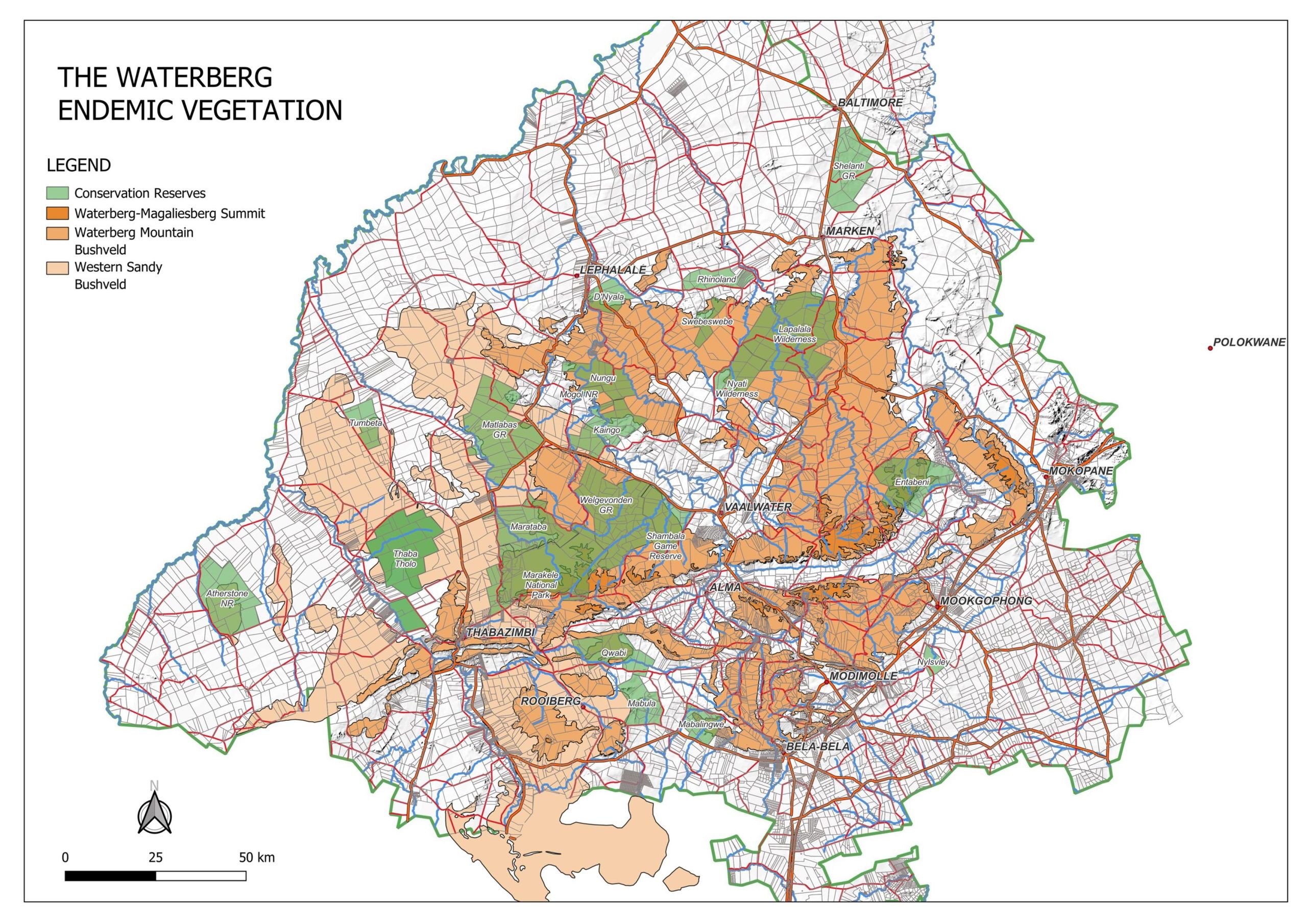
The Waterberg region is home to a total of 20 unique ecosystems, three of which are near-endemic—meaning they extend slightly into surrounding areas in Limpopo and Botswana. More critically, however, the region also hosts three ecosystems that are fully endemic to the Waterberg District. These endemic ecosystems occupy an extensive area of almost 1.4 million hectares, constituting approximately 33% of the entire district.
The significance of these endemic ecosystems cannot be overstated. They form the basis for special conservation designations, such as Key Biodiversity Areas (KBA) and Important Bird and Biodiversity Areas (IBA), which prioritize the protection of rare and ecologically vital regions. Recognizing and documenting the distribution of these ecosystems is crucial for safeguarding them, especially in the context of mining and development applications. Highlighting the presence of these endemic ecosystems in assessments, comments, and objections helps build a strong case for their protection, countering development pressures and ensuring these irreplaceable habitats remain preserved for the future.
Among the three endemic ecosystems within the Waterberg District, only the Waterberg-Magaliesberg Summit Sourveld currently enjoys an adequate level of protection. The other two, the Waterberg Mountain Bushveld and the Western Sandy Bushveld, remain under-protected and fall short of meeting critical conservation targets.
Enhancing protection for the Waterberg Mountain Bushveld and Western Sandy Bushveld is essential, as both ecosystems contribute uniquely to the region’s biodiversity and ecological resilience. Without targeted conservation efforts, these areas risk degradation from development pressures, making it imperative to advocate for their inclusion in conservation planning to secure their ecological future. Again, another spatial consideration for mining or other developments within the Waterberg landscape.