The Waterberg Landscape Alliance, originally established as Save the Waterberg Rhino, was formed at the end of 2012 in response to the surge in rhino poaching that began affecting the Waterberg around 2010. The core objective was to bring rhino owners, private landowners, conservation reserves, and security personnel together to work collaboratively rather than in isolation. This collective approach enabled the sharing of information, resources, and capacity, as well as coordinated planning, joint deployment of technology, and the development of shared protocols. By combining efforts, partners were better positioned to conduct coordinated operations and disrupt wildlife crime, leading to more effective detection and apprehension of offenders.
The outcomes of the Waterberg’s collective approach have been exceptional. Over time, this collaboration has built a well-resourced and highly experienced conservation and security capacity, resulting in a trusted Greater Waterberg Network that has been supported and facilitated by the Waterberg Landscape Alliance for more than thirteen years. Through WLA, the Waterberg has received critical financial support to combat rhino poaching from organisations including Baby Rhino Rescue, the Rhino Recovery Fund (Wildlife Conservation Network), My Planet Rhino, ConservEarth, Tusk (UK), and The Waterberg Trust, as well as from numerous individual donors who have contributed directly or undertaken fundraising initiatives on WLA’s behalf (check out our Donor Appreciation Page). In addition, WLA has played a central facilitation role by providing effective platforms for communication, coordination, and collective action across the landscape.
The effectiveness of the Waterberg’s approach is demonstrated by both consistently low rhino poaching rates and strong law-enforcement outcomes. In the Waterberg, poachers are more than ten times more likely to be arrested and successfully convicted than in other major rhino-poaching hotspots.
Both black and white rhino occur within the Waterberg, with approximately 10% of the region supporting rhino populations. Rhinos are of critical importance to the Waterberg, both as a cornerstone of the tourism economy—one of the region’s most significant economic sectors—and as landscape engineers. As large megaherbivores, they play a vital ecological role by shaping vegetation structure and creating habitat conditions that benefit a wide range of other species across the landscape.
South Africa
451
Limpopo
38
Waterberg
18
South Africa
448
Limpopo
25
Waterberg
12
South Africa
499
Limpopo
59
Waterberg
15
South Africa
420
Limpopo
56
Waterberg
7
South Africa
352
Limpopo
36
Waterberg
17
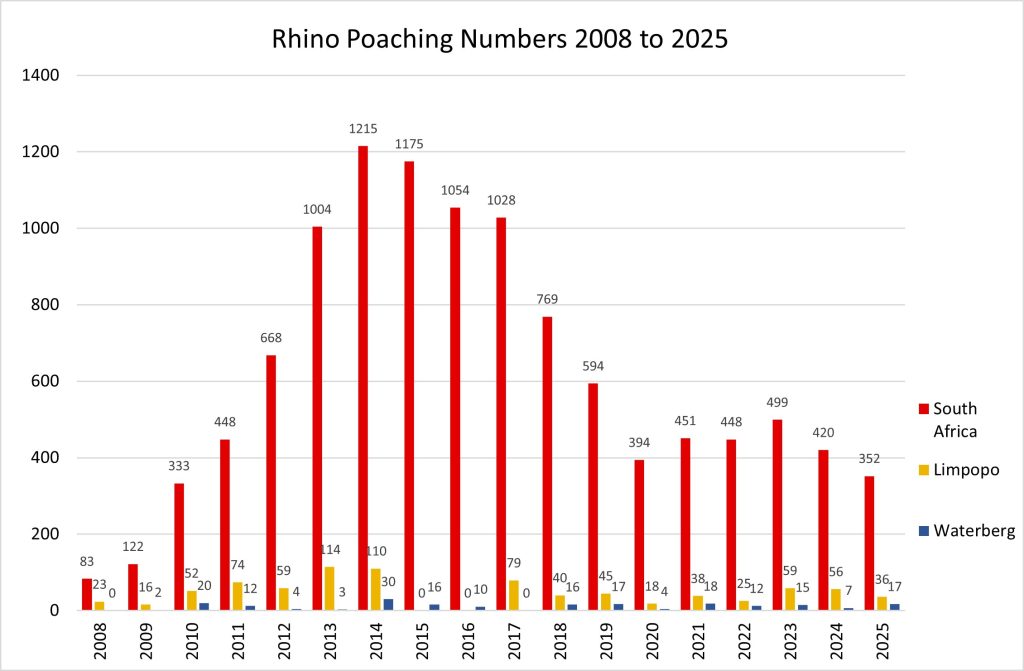
The graph provides a breakdown of rhino poaching in South Africa, with national totals alongside comparative figures for Limpopo and the Waterberg. Data sources: DFFE, Stoprhinopoaching.com (South African and Limpopo) and SAPS Endangered Species Unit (Waterberg).
At the heart of the Waterberg’s conservation success is the Greater Security Network — a coordinated, district-wide system that brings together private landowners, conservation reserves, NGOs and state authorities. Spanning more than 4.5 million hectares, the Network functions as a unified protection framework, combining advanced technology, real-time information sharing, joint patrols and rapid-response capability to prevent poaching before it happens.
Its strength lies not only in its scale, but in its cooperative ethos. Rather than fragmented, property-by-property efforts, the Waterberg has built a culture of collaboration. This integrated approach — pooling resources, intelligence and expertise — has made the landscape significantly harder for poaching syndicates to penetrate and has created the conditions for rhino populations to stabilise and recover.
In the Waterberg, wildlife criminals are consistently apprehended, resulting in high arrest and conviction rates that demonstrate the success of the region’s protection efforts.
The impact extends well beyond rhino protection. A safer Waterberg strengthens community resilience, enhances rural security and supports a thriving wildlife-based economy that sustains jobs and livelihoods. By safeguarding this landscape, the Network contributes to national and global conservation targets while ensuring that rhino protection forms part of a broader, inclusive and sustainable future for the region.
The Waterberg plays a leading role in connecting local action with South Africa’s national rhino protection efforts. As an active member of the Integrated Wildlife Zone (IWZ), the region participates in quarterly national forums that review progress, analyse incidents and address emerging challenges across the country. Within this framework, the Waterberg is widely recognised as a model of effective coordination, intelligence-sharing and proactive management — demonstrating what is possible when landscapes work collectively.
Performance is also benchmarked against the objectives of the National Integrated Strategy to Combat Wildlife Trafficking (NISCWT), where regional contributions are regularly evaluated. The Waterberg consistently ranks among the top-performing regions, frequently meeting and exceeding national targets. This sustained performance underscores the region’s significant contribution to rhino protection — not only within the Waterberg, but as part of South Africa’s broader, coordinated response to wildlife crime.
The Waterberg today represents one of the great strongholds for rhinos in South Africa. Here, rhinos are not only surviving but also reproducing, with the potential to produce 80–120 calves annually. Each calf represents the success of collective action — a tangible symbol of conservation at work.
Every technology deployed, every patrol coordinated, and every poacher intercepted increases the likelihood that these calves will reach maturity. In a world where poaching, organized crime, and climate change pose constant threats, the Waterberg stands as a model for how collaboration, persistence, and innovation can secure a future for rhinos.
In a country where poaching pressure remains intense, the Waterberg continues to stand out as a place of resilience.
Every rhino saved, every global trafficking ring dismantled, and every extra space available for rhinos brings us closer to a future where they can thrive in the wild.